We are continously updating: So re visit us Soon

18 Dec 2013

Man's severed hand grafted to ankle after accident :


Doctors in China have saved a man's severed hand by grafting it onto his ankle. Xiao Wei lost his right hand in an accident at work, but could not have it reattached to his arm immediately. Instead the hand was kept alive by stitching it to Xiao's left ankle, enabling him to borrowing a blood supply from arteries in the leg

Nurse

Nurses are next best to angles

16 Dec 2013

Biostats Quizz: Sampling techniques

1. Random sampling or probability sampling includes all the following techniques, except:
A. Simple random sampling
B. Stratified random Sampling
C. Cluster sampling
D. Purposive Sampling
2. Gender, age-class, religion, type of disease, and blood group are measured on:
A. Nominal scale of measurement
B. Ordinal scale of measurement
C. Interval scale of measurement
D. Ratio scale of measurement

3. Which scale of measurement has an absolute zero?
A. Nominal
B. Ordinal
C. Interval
D. Ratio

4. The variable which is influenced by the intervention of the researcher is called:
A. Independent
B. Dependent
C. Discrete
D. Extraneous

5. The statistical approach which helps the investigator to decide whether the outcome of the study is a result of factors planned within design of the study or determined by chance is called:
A. Descriptive statistics
B. Inferential statistics
C. Normal distribution
D. Standard deviation

6. Which of the following methods is a form of graphical presentation of data?
A. Line Diagram
B. Pie diagram
C. Bar diagram
D. Histogram

7. All the following are measures of central tendency, except:
A. Mean
B. Median
C. Mode
D. Variance

8. Which measure of central tendency is Influenced by extreme scores and skewed distributions?
A. Mean Copyright@ http://nursingplanet.com/Quiz
B. Median
C. Mode
D. Range
9. A measure of central tendency which is calculated by numbers arranging in numerical order is:
A. Standard deviation
B. Range
C. Median Copyright@ http://nursingplanet.com/Quiz
D. Mode
10. The proportion of observations fall above the median is:
A. 68%
B. 50%
C. 75%
D. 95%

11. The indices used to measure variation or dispersion among scores are all, except:
A. Range
B. Variance
C. Standard deviation
D. Mean
12. A measure of dispersion of a set of observations in which it is calculated by the difference between the highest and lowest values produced is called:
A. Standard deviation
B. Variance Copyright@ http://nursingplanet.com/Quiz
C. Range
D. Mode
13. A statistic which describes the interval of scores bounded by the 25th and 75th percentile ranks is:
A. Inter quartile range
B. Confidence Interval
C. Standard deviation
D. Variance Copyright@ http://nursingplanet.com/Quiz

14. The Median value is the:
A. 25th percentile
B. 50th percentile
C. 75th percentile
D. 95th percentile

15. Large standard deviations suggest that:
A. scores are probably widely scattered.
B. there is very little deference among scores.
C. mean, median and mode are the same
D. the scores not normally distributed.

16. The formula given below is computational formula for:
A. Variance
B. Mean Copyright@ http://nursingplanet.com/Quiz
C. Standard deviation
D. t-statistic

17. The squire of the standard deviation is the:
A. Variance.
B. Standard error
C. Z-score Copyright@ http://nursingplanet.com/Quiz
D. Variance

18. Which is NOT a characteristic of normal distribution?
A. Symmetric Copyright@ http://nursingplanet.com/Quiz
B. Bell-shaped
C. Mean = median = mode
D. Negative skewness
19. Skewness is a measure:
A. of the asymmetry of the probability distribution
B. decides the distribution may have high or low variance
C. of central tendency
D. None of the above
20. The formula given below is used to calculate:
O= Observed frequency
E= Expected frequency
A. t-test statistic
B. chi-squire statistic
C. correlation coefficient
D. Standard deviation
Answer Key

Answers

Answer Key 
1. D
2. A
3. D
4. B
5. B
6. D
7. D
8. A
9. C
10. B
11. D
12. C
13. A
14. B
15. A
16. C
17. D
18. D
19.A
20. B

References
  1. Polit H, Beck C T. Nursing research. 8th ed. New Delhi: Williams and Wilkins; 2008.
  2. Burns N, Grove S K. Understanding nursing research. 4th ed. New Delhi: Elsevier; 2007.
  3. Park JE, Park K. Text Book of Preventive and Social Medicine. 19th Edition. Jabalpur: M.S. Banarsidas Bhanot; 2007.
  4. Questions from entrance examinations relevant to nursing conducted in India. (NIMHANS/AIIMS/Manipal/Kerala/All India etc..)
  5. Cohen J. Statistical Power Analysis for the Behavioral Sciences. Erlbaum, Hillsdale, NJ; 1988.

Biostatistics Quizz Sampling

K meanings: Nursing Language


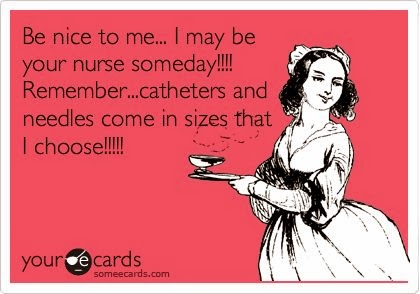
Be Nice to nurse !


15 Dec 2013

Nursing Research Quiz online

Nursing care Plans : Test your knowldge


NO 
YB 
YS 
NA 
C-1
I use critical thinking, professional judgment and reasoned decision-making to develop care plans. 
C-2
I have the knowledge and ability develop care plans and establish client care priorities. 
C-3
I involve clients in identifying their preferred health outcomes. 
C-4
I anticipate potential health problems or issues and their consequences for clients.
C-5
I explore and develop a range of possible care alternatives and approaches with clients.
C-6
I am aware of the influence of positional power relationships when negotiating priorities of care with clients.
C-7
I encourage client ownership of their care plans.
C-8
I develop care plans with other health team members to ensure continuity of care.
C-9
I know when consultation is required with other team members or health related sectors.
C-10I make clients aware of, and assist them to access, community health and wellness resources.

I: Infusion Therapy Quiz online

I: Infusion Therapy 
No.
Competency 
NO 
YB 
YS 
NA 
I-1 I know human anatomy and physiology, specifically the circulatory system, fluids, and electrolytes. 
I-2I know the principles of infusion therapy. 
I-3I know the related terminology such as infusion, interstitial and intravenous.
I-4I can differentiate between peripheral lines, central lines, implanted ports, and epidurals.
I-5I can initiate, monitor, maintain, regulate, discontinue and evaluate peripheral infusion therapy.
I-6I can identify common intravenous solutions according to type of solution, additional contents, and indications for use.
I-7I know how to set-up and prime an infusion line.
I-8I can use a variety of infusion therapy equipment.
I-9I have the ability to calculate infusion rates.
I-10I can recognize complications of intravenous therapy as related to etiology, clinical manifestations, and take preventative nursing measures.
I-11I can resolve common problems associated with peripheral intravenous therapy.
I-12I can initiate, flush, monitor and discontinue heparin and saline locks in established peripheral infusion sites.
I-13I can prepare and administer medications for infusion as per medication order.
I-14I can provide retrograde push medications via peripheral intravenous infusions in specific settings.
I-15I can initiate, monitor and regulate Total Parenteral Nutrition (TPN).
I-16I have knowledge of the peripheral venous system.
I-17I can identify common IV puncture sites.
I-18I can initiate and discontinue peripheral infusion and remove infusion catheter.
I-19 I know the different types of central lines and the terminology used by my agency.
I-20I am aware of the risks associated with central lines. 
I-21I can provide basic care to a client with a central line as per agency policy.
I-22I can monitor the central line infusion.
I-23I can provide additional care to a client with a central line.
I-24I can maintain central venous pressure while providing care of the central line.
I-25I know the purpose of hypodermoclysis.
I-26I can provide medications and fluids via hypodermoclysis.
I-27I can initiate, monitor, maintain, regulate, and evaluate hypodermoclysis infusion.
I-28I can identify and describe complications of hypodermoclysis related to etiology and clinical manifestation.
I-29I know how to discontinue hypodermoclysis.
I-30I can document hypodermoclysis therapy.
I-31I know the circulatory system and components of blood and blood products.
I-32I know the normal lab values pertaining to blood transfusion. 
I-33I know the common blood transfusions according to composition and indications for use.
I-34I have knowledge of blood typing and cross-matching of blood.
I-35I have knowledge and awareness of the ethical and religious beliefs regarding blood transfusions.
I-36I have knowledge and understanding of client's legal right to refuse blood or blood products.
I-37 I can set up for a blood administration.
I-38I know how to obtain blood or blood products from blood bank as per agency policy.  
I-39I check patient identification with label on blood or blood product. 
I-40I can monitor and regulate administration of blood or blood products.
I-41I can recognize a reaction to blood or blood products and change blood infusion to normal saline.
I-42I can discontinue a blood transfusion.
I-43I can monitor and evaluate therapeutic and non-therapeutic responses to blood transfusion.
I-44I can effectively document information regarding transfusion therapy.
I-45I have knowledge of agency policies pertaining to blood transfusions.

« »